


Post Single
Posted by:
Comments:
Post Date:
Introduction
Choosing a CMMS is not about picking the software with the most features. The right system fits the organization’s size, maintenance needs, workforce, and day-to-day operations.
For storage and warehouse teams, a CMMS should make it easier to manage assets, work orders, inspections, spare parts, and vendors without adding unnecessary work.
Instead of asking, “How many features does it have?” ask, “What maintenance problems do we need it to solve?” This helps organlizations choose a system that works today and can grow with them.
📌 Key Takeaways
- The best CMMS depends on operational complexity, not simply company size.
- Small operations should prioritize simplicity, essential work order management, and affordability.
- Medium operations benefit from stronger capabilities in assets, parts, vendors, and reporting.
- Large operations need scalability, standardized workflows, advanced reporting, and stronger governance.
- A basic CMMS can still provide significant value when it solves the organization's most important maintenance challenges.
What Should a CMMS Actually Manage?
At its core, a CMMS helps organizations organize maintenance information and turn maintenance requests into trackable work. Common capabilities include asset management, work order management, parts tracking, vendor management, maintenance history, and reporting.
For a storage organization, this might mean recording an asset, identifying a problem, determining whether a spare part is available, creating a work order, and assigning the work to an internal employee or external vendor. Keeping these activities connected creates a clearer maintenance history and reduces the need to manage information across separate spreadsheets or documents.
However, not every organization requires an advanced CMMS with extensive automation and complex maintenance analytics. The right level of functionality depends on the organization's operational maturity.
CMMS for Small Operations
Small operations usually have fewer assets and smaller teams, so their main challenge is keeping maintenance organized. A CMMS should provide simple asset records, easy work order creation, spare-parts tracking, vendor assignment, maintenance history, mobile access, and basic reporting.
For example, if a damaged door is found during an inspection, the team can check available parts, create a work order, and assign the repair to a vendor.
For small teams, a simple and easy-to-use CMMS is often more useful than a system packed with features they rarely need.
CMMS for Medium-Sized Operations
As an organization grows, managing maintenance manually becomes harder. More assets, locations, vendors, and employees require better coordination and visibility.
A medium-sized operation should look for a CMMS with centralized asset management, spare-parts and vendor tracking, work order prioritization, maintenance history, task assignment, inspection integration, and clear reports and dashboards.
At this stage, connecting inspections with maintenance can make a big difference. An inspection issue can quickly become a work order linked to the right asset and vendor, creating a clear path from finding a problem to completing the repair.
CMMS for Large Operations
Large organizations face a different challenge: keeping maintenance consistent across many locations. With thousands of assets, multiple teams, and vendors, they need strong coordination and visibility.
A CMMS should support multiple locations and asset hierarchies, standardized workflows, role-based access, preventive maintenance, parts inventory, vendor management, detailed maintenance history, reporting and analytics, and integration with other systems.
Scalability is key. The right CMMS should keep processes consistent across sites while giving each facility enough flexibility to handle its specific needs.
Where SiteWare Fits
SiteWare provides practical CMMS capabilities for organizations that need to manage core maintenance workflows without adopting an unnecessarily complex enterprise maintenance system.
Within SiteWare, organizations can manage assets, parts, vendors, and work orders. When an asset requires attention, teams can create or update the asset record, identify an appropriate spare part, and create a work order for the required maintenance. That work order can then be assigned to a vendor or responsible team member.
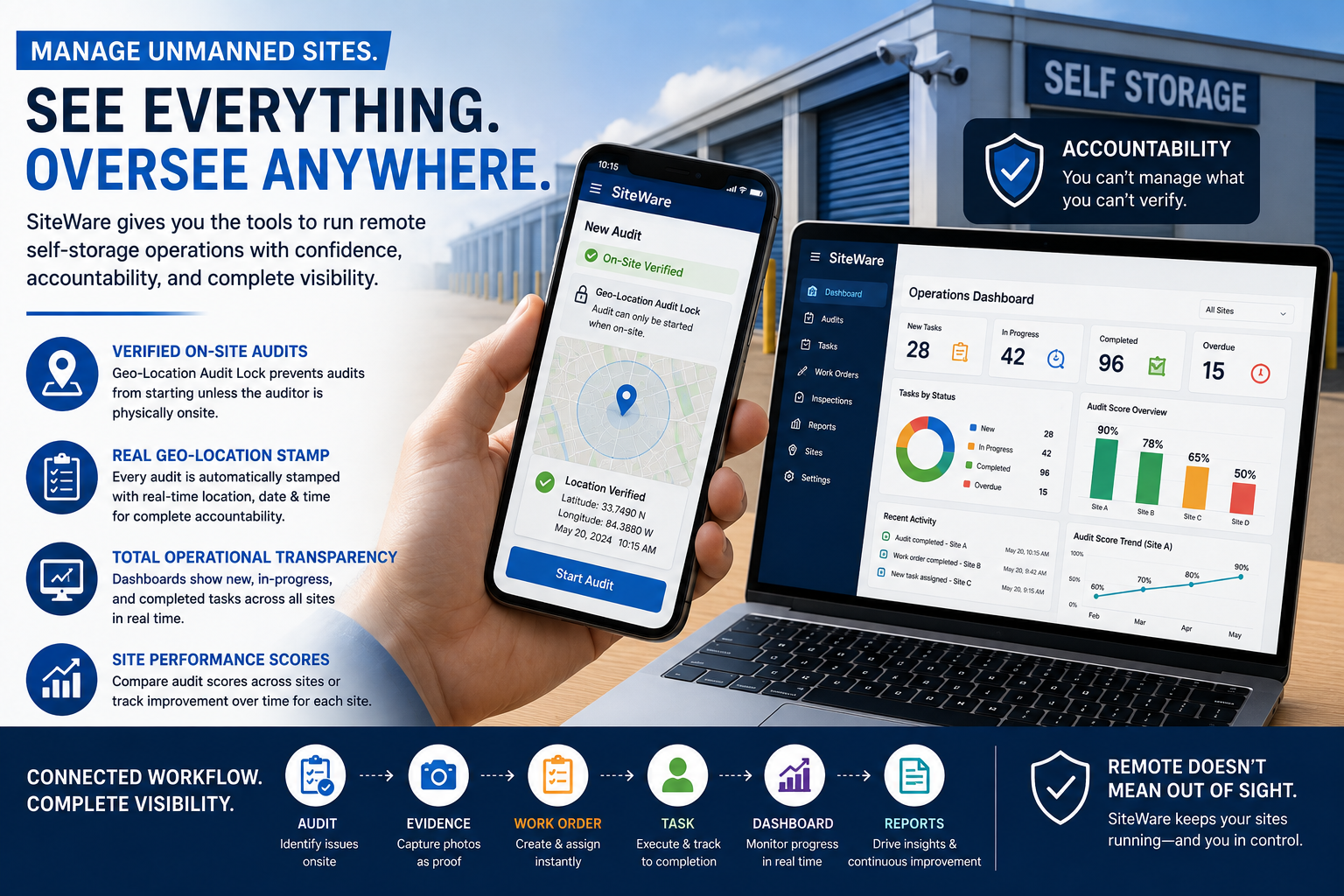
SiteWare also connects maintenance activities with broader operational workflows. Teams can conduct inspections, upload photographs of problems, create work orders from audit findings, assign tasks, and monitor progress through responsive dashboards and reports.
This makes SiteWare particularly useful for storage organizations that need basic, connected CMMS functionality alongside audits, inspections, tasks, and operational management rather than a highly complex enterprise maintenance platform.
Conclusion
There is no single “best” CMMS. The right choice depends on your organization’s size, maintenance needs, workforce, assets, and future plans.
Small teams may only need simple asset and work order management. Medium-sized operations often need better coordination between assets, parts, vendors, inspections, and maintenance. Large organizations need scalable systems that work across multiple locations.
For storage operations, SiteWare combines CMMS features with audits, inspections, tasks, work orders, dashboards, reports, and checklists. The goal is to keep maintenance organized without adding unnecessary complexity.
Ultimately, the best CMMS is one that fits your current workflow and can grow with your operation.
Ultimately, the best CMMS is the one that fits the way your organization actually works today while providing enough flexibility to support where the operation is going next.
